Terahertz research

See the field,
not just the spectrum.

TeraSpike microprobes sample the THz electric field directly at the surface of resonators, metasurfaces and plasmonic structures. You get amplitude and phase, each vector component and the full time evolution, at micrometre resolution and with minimal disturbance of the structure.

Pulse-excited metamaterial surface Ex · near field
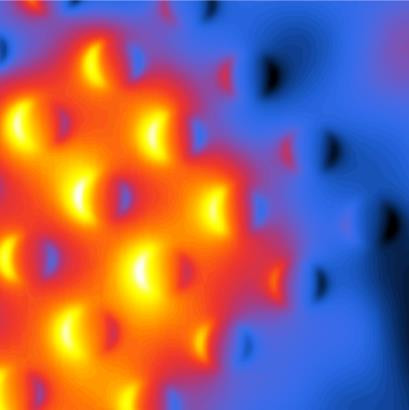
False-colour near-field map of the transversal THz field component Ex above a pulse-excited metamaterial surface, showing a periodic pattern of field maxima on the resonator array.
Measured near-field image of a pulse-excited THz metamaterial surface, transversal field component.
3 µm
Max. spatial resolution
Ex · Ey · Ez
Selectable field component
0–4 THz
Frequency range
Amplitude & phase
Coherent, time-resolved
The problem

The far field hides what the resonator does.

Far-field spectroscopy measures what leaves the sample, averaged over many unit cells. The field that matters for sensing, coupling and surface waves sits within a few micrometres of the surface. Its spectral response can differ markedly from the far-field one: near-field resonances have been shown to sit at clearly different frequencies than the far-field extinction peaks of the same structure.

Measure · 01

Amplitude, phase, time

Each pixel is a full time-domain waveform. Maps at any delay show how the field builds up and rings down; a Fourier transform per pixel gives spectral amplitude and phase maps.

Measure · 02

The vector, component by component

X-series probes pick up the field transversal to the tip axis; rotating the probe switches between Ex and Ey. Z-series probes measure the longitudinal component Ez, normal to the surface.

Measure · 03

Low invasiveness

The unscreened, non-resonant probe tip is only micrometres thick. It can be brought into the near field of a single resonator without noticeably shifting the resonance it is measuring.

Measured examples

What the maps look like.

3D vector field mapping

Three components of one field.

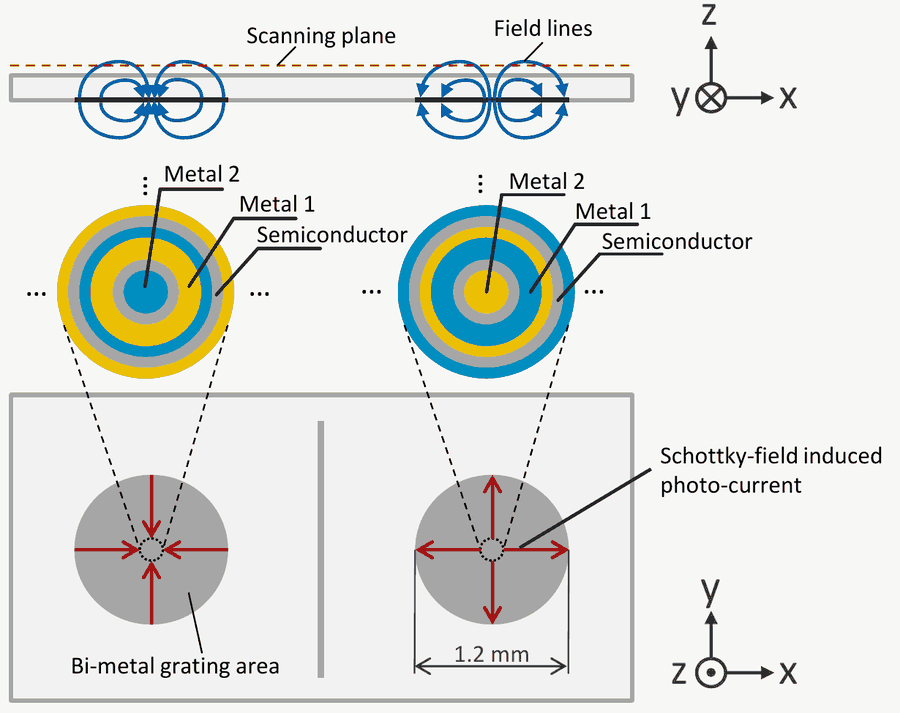
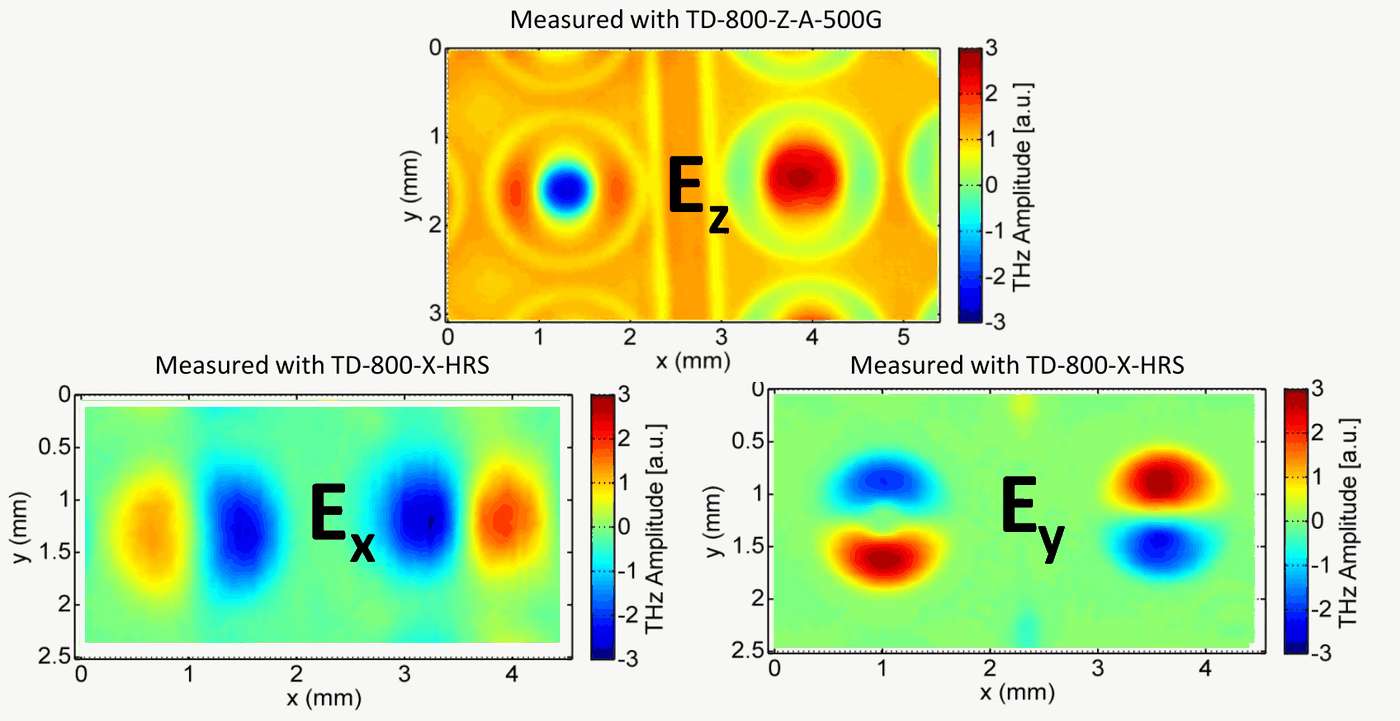
Device under test: a pair of radial-mode THz emitters based on planar bi-metal gratings. A Schottky-field-induced photocurrent flows radially inward on one emitter and outward on the other. Mapping Ex, Ey and Ez in one scanning plane reconstructs the full vector field above the device.

Ez
TeraSpike TD-800-Z (longitudinal)
Ex, Ey
TeraSpike TD-800-X-HRS (transversal), two probe orientations
Device
Emitter diameter 1.2 mm
Three THz amplitude maps of the same emitter pair: Ez measured with a TD-800-Z probe shows a negative and a positive peak at the two emitter centres; Ex and Ey measured with a TD-800-X-HRS probe show dipole-like lobes oriented along x and y.
Measured Ez (top), Ex and Ey (bottom) in a scanning plane above the emitter pair.
Schematic of the device: cross-section with field lines and scanning plane, zoomed concentric bi-metal grating rings, and top view of two radial-mode emitters with inward and outward photocurrent arrows, 1.2 mm diameter.
Device: cross-section with field lines and scanning plane, grating detail and top view.
Metamaterial sensor surface

A sensor surface, picoseconds apart.

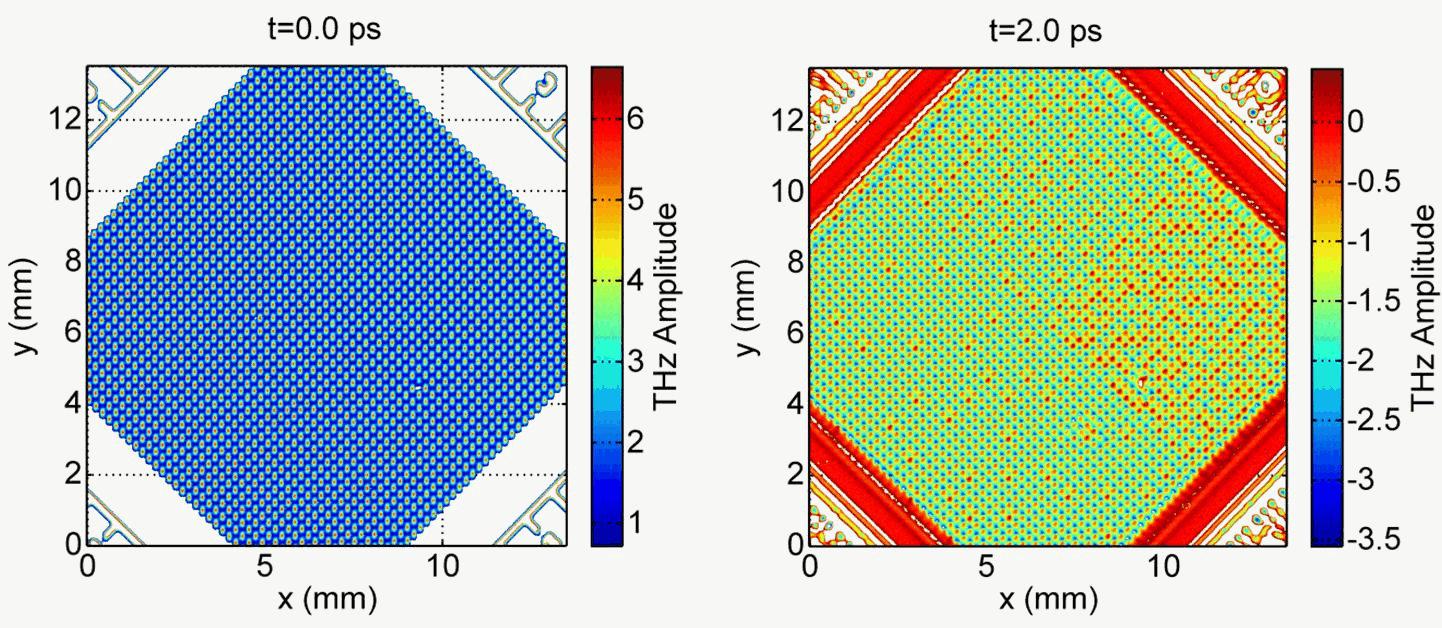
THz near-field distribution at a metamaterial surface for sensing applications, locally loaded with sample material. Two frames from one time-resolved mapping: the peak excitation state and the field 2 ps later.

Map size
approx. 13 × 13 mm²
Data
Full transient per pixel; frames at selected delays
Two THz amplitude maps of a square metamaterial resonator array rotated by 45 degrees: left at t = 0 ps with uniform excitation, right at t = 2.0 ps with a varying field pattern across the array.
Left: peak excitation (t = 0 ps). Right: 2 ps after excitation.
From the literature

Published with TeraSpike probes.

A selection of work by research groups and by Protemics in which our microprobes or TeraCube systems were used. Protemics marks papers co-authored by Protemics.

All publications on metamaterials & plasmonics →

What it takes

The instruments behind it.

TeraSpike probes fit most laser-based THz time-domain systems with excitation below 860 nm — or come fully integrated in the TeraCube M2 scanner.

Two ways in

Map your structure.

Tell us what you need to see — a resonance, a coupling, a surface wave. We'll tell you which probe, which field component and which scan will show it.

Service

Send us a sample

We map your metamaterial, antenna or plasmonic device in Aachen and deliver the time-resolved field data together with a short report.

Instrument

Equip your lab

Add TeraSpike probes to your existing THz-TDS setup, or work with a complete TeraCube M2 near-field scanner.