Seven probe types in ten configurations — sensitive to transversal, longitudinal or emitted THz fields, sampled at 800 nm or telecom wavelength. Spatial resolution narrows the choice fastest, so start there.
Field orientation and excitation wavelength are set by your setup; resolution and mode by your sample. Combine the filters to narrow the range.
No probe matches that combination. Clear a filter, or tell us what you need to measure.
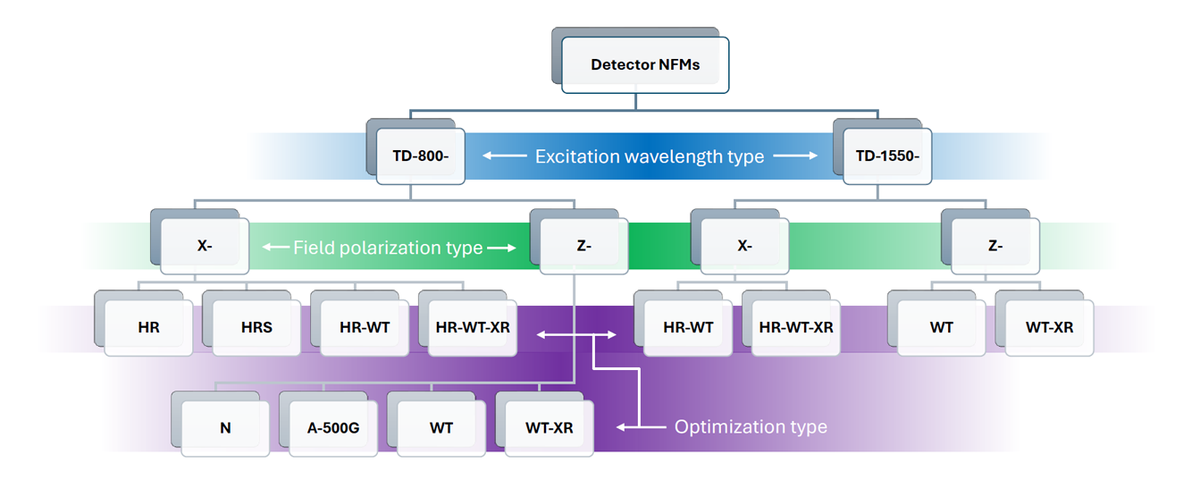
A detector name tells you three things: the excitation wavelength (TD-800 or TD-1550), the field polarization it is sensitive to (X: transversal, Z: longitudinal) and the optimization type, e.g. HR, HRS, N, A-500G or the WT and XR options.
Both options are patent-pending cantilever designs, available for the x- and z-field sensitive probes.
Tell us the field orientation you need to resolve, your laser wavelength and your working distance — we'll name the probe and the option, and say when none of them fits.