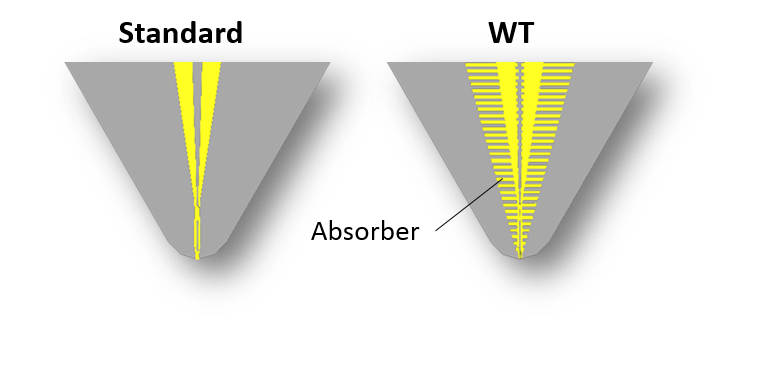
Two design options that adapt a TeraSpike probe to the measurement: the wave-trap removes probe-internal ghost signals from long time windows, the XR cantilever makes the tip robust where the sample distance is hard to control.

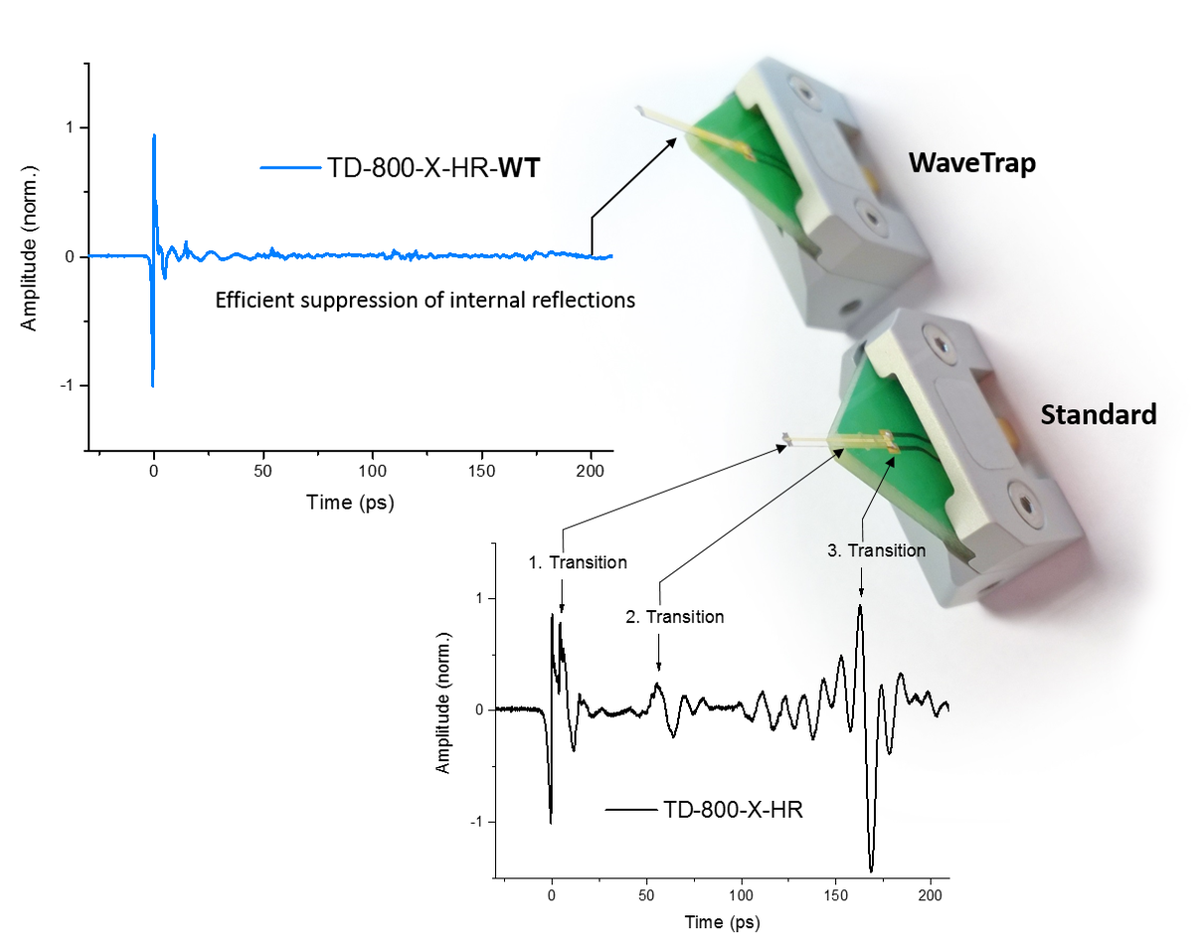
Measured transients with and without wave-trap: the reflections from the probe-internal electrodes vanish.
Under some excitation conditions an incident THz wave couples to the planar electrodes of the probe tip and travels along them. At the probe-internal waveguide transitions it is reflected and shows up as a “ghost” signal in the recorded transient — a problem whenever long time ranges are measured.
The wave-trap electrode design slows down and absorbs any THz wave picked up by the tip, so the parasitic reflections disappear.
Interested in a WT-option for another model? Contact us.
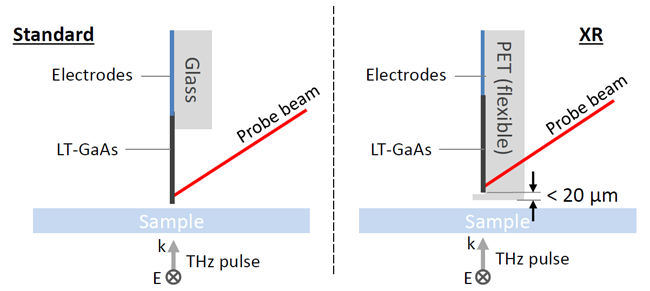
The standard TeraSpike design is optimized for highest spatial resolution, lowest field invasiveness and highest sensitivity — a free-standing semiconductor cantilever carries the active sensor elements. Its robustness matches long-term use in well-controlled, automated systems such as the TeraCube, including gentle sample contact.
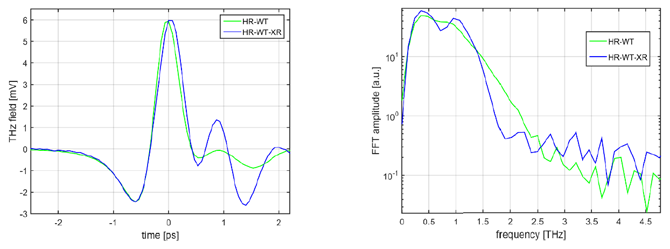
For rougher environments, or where the sample distance is hard to control, the XR design offers drastically increased mechanical robustness with only a small reduction of resolution and sensitivity.
Tell us your measurement window and setup — we'll tell you whether WT, XR or both make sense.