Why THz biosensing needs the near field
Biomolecular sensing is an attractive field for terahertz technology: many characteristic spectral features of biomolecules lie in the THz range, which makes label-free detection possible in principle. Very early, however, the large amount of identical sample material required for sufficient contrast in diffraction-limited (far-field) spectroscopy was identified as a major obstacle [1].
A first demonstration of drastically reducing the required amount succeeded in 2002, using the near field of a single waveguide-embedded THz resonator to detect short DNA strands [2]. Multiplying the sensor elements into resonator arrays increased the number of molecules that could be detected on one chip [3]. Exciting and reading out resonator arrays with free-space THz radiation instead of guided modes on multichannel on-chip structures [4] then triggered a lot of research — but sensitivity was lost again, because far-field detection requires ensemble read-out instead of single-resonator read-out. Progress on the resonator side, such as higher quality factors [5] and stronger local field enhancement [6], has since recovered part of that sensitivity.
Latest advance: STRING
A consortium from Sungkyunkwan University, MIT and the University of Minnesota has now demonstrated spectrally selective detection of exemplary biomolecules at sensitivities in the sub-picogram range (Ha et al., Nano Letters 2022) [7] — according to the authors, an increase of “10 orders of magnitude compared to far-field THz measurements with pelletized samples”.
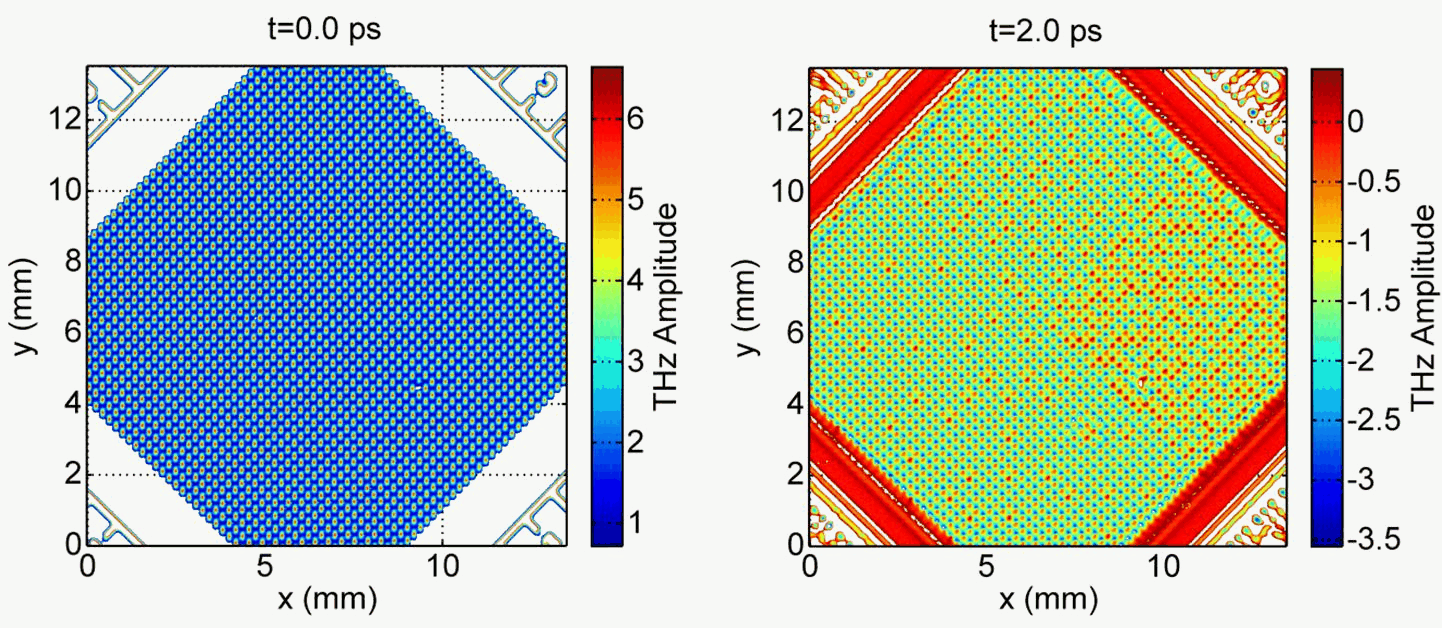
The breakthrough comes from combining dedicated field-enhancing structures with THz sub-wavelength imaging in a TeraCube near-field system. Excitation still uses a simple far-field THz beam, but the response of a single resonator loaded with biomolecules is monitored instead of a large ensemble. The authors call the method STRING — “Subwavelength Terahertz Resonance Imaging”.
The sensor response contains spectral and spatial information on the resonance modes under molecular load.
This spatial information about the generated resonance modes may help to increase selectivity further in the future.
References
- Brucherseifer et al., Appl. Phys. Lett. (2000). 10.1063/1.1332415
- Nagel et al., Appl. Phys. Lett. (2002). 10.1063/1.1428619
- Janke et al., CLEO (2005). CLEO-2005-CFM7
- Debus et al., Appl. Phys. Lett. (2007). 10.1063/1.2805016
- Yan et al., Opt. Express (2021). 10.1364/OE.417367
- Xie et al., Sci. Rep. (2015). srep08671
- T. Ha, D. Yoo, C. Heo et al., Subwavelength Terahertz Resonance Imaging (STRING) for Molecular Fingerprinting, Nano Lett. 22(24), 10200–10207 (2022). 10.1021/acs.nanolett.2c04610 · IBS CINAP